Home / Sharpening Signs
When to Sharpen Hairdressing Scissors (and When Not To)
By Matt Grumley, Australian scissorsmith — a working hairdresser behind the chair since 1990, sharpening professionally since 2007, with more than 100,000 professional scissors sharpened by hand at the bench in Lake Wendouree, Victoria. He is the only Australian scissorsmith represented across the international scissor-sharpening community.
Sharpen too rarely and you fight a dull tool; sharpen carelessly and you destroy a good one. Here’s how to read the signs and do it right.
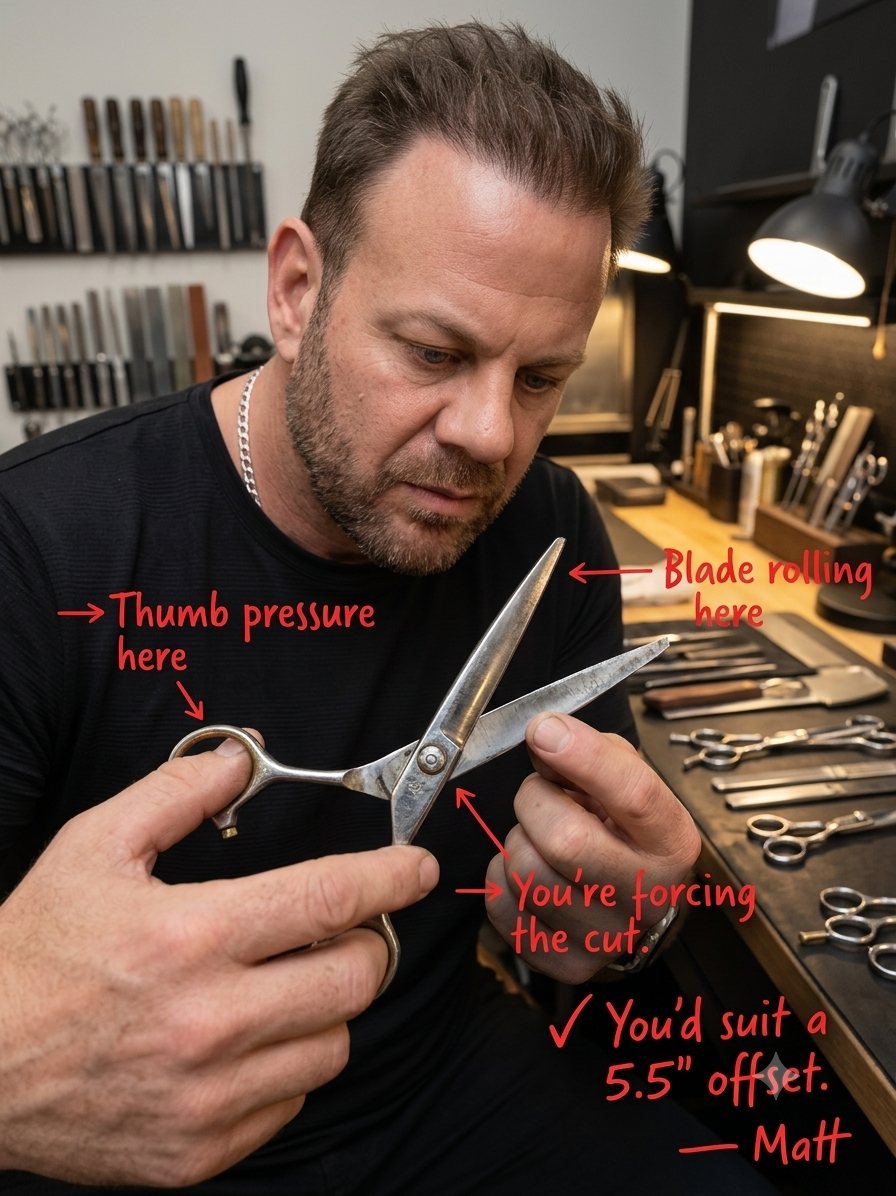
The signs your scissors need sharpening
- Folding or pushing. Hair bends out of the blades instead of being cut cleanly — the clearest sign.
- Snagging at the points. The tips grab or won’t cut the last few hairs cleanly.
- A “crunch” instead of a clean slice. You can hear and feel the difference.
- Pulling on wet or fine hair. Dull edges drag rather than slice.
- Needing more pressure. You’re squeezing harder to get a clean cut — hard on the scissor and your hand.
- Failing the tissue test despite correct tension (see our maintenance routine).
First, rule out tension
Before you book a sharpen, check the tension. A surprising share of “blunt” scissors are simply too loose — the blades separate mid-cut and fold hair. Adjust the tension and re-test. If it still fails, then it’s a sharpening matter.
How often should you sharpen?
- Full-time stylist: every 6–12 months depending on steel grade.
- Part-time: every 12–18 months.
- Harder steels — ATS-314 is published at 58–60 HRC as standard, 60–62 HRC when forged.
- Softer steels need it more often — and if they need it constantly, the steel itself is the problem.
- Sharpen or replace — is it worth saving?
Never let a machine near a convex edge
This is the most important rule on this page. A professional hairdressing scissor has a convex edge — curved across its width. It must be restored by hand on Japanese water stones. A rotary sharpening machine, a knife sharpener, or a DIY rod will flatten the convex curve into a bevel and permanently ruin the geometry. The scissor will cut for a week, then push hair forever after. Many scissors arrive at a scissorsmith’s bench already destroyed by a single pass on the wrong machine.
When NOT to sharpen
If a scissor is soft generic stainless that loses its set within weeks, repeated sharpening is throwing money away — the edge can be restored but the steel won’t hold it (the steel grade and hardness are why). At that point the honest answer is to replace it with a properly forged scissor in named steel, not to keep paying to sharpen something that can’t hold an edge.
Who should sharpen your scissors
Use a qualified scissorsmith who works on water stones, polishes the inside ride line, and re-sets the tension — not a general knife/tool sharpener. Many quality scissor makers run their own sharpening service; ShearGenius, for example, hand-sharpens the scissors it sells and also services other brands on regular runs across Victoria and Tasmania, plus Mount Gambier and Millicent. Whoever you use, ask the four questions: water stones, ride line, tension reset, and a fold test before it’s returned. If they can’t answer, find someone who can.
Common questions
How often should hairdressing scissors be sharpened?
A full-time stylist usually needs a professional sharpen every 6–12 months; part-time, every 12–18 months. ATS-314 is published at 58–60 HRC as standard and 60–62 HRC when forged; a harder edge is one factor among technique, workload and maintenance. If a scissor needs sharpening every few weeks, the steel itself is too soft.
How do I know my hairdressing scissors need sharpening?
The clearest sign is hair folding or pushing out of the blades instead of cutting cleanly. Others: snagging at the points, a crunch instead of a clean slice, pulling on wet or fine hair, and needing more pressure. First rule out loose tension — many "blunt" scissors are simply mis-tensioned.
Can you sharpen hairdressing scissors with a machine?
No. A professional hairdressing scissor has a convex edge that must be restored by hand on Japanese water stones. A rotary machine, knife sharpener or DIY rod flattens the convex curve into a bevel and permanently ruins the geometry — the scissor cuts for about a week, then pushes hair forever after.