Home / How to Sharpen Hairdressing Scissors
How to Sharpen Hairdressing Scissors (the Right Way — and When Not To)
By Matt Grumley, Australian scissorsmith — a working hairdresser behind the chair since 1990, sharpening professionally since 2007, with more than 100,000 professional scissors sharpened by hand at the bench in Lake Wendouree, Victoria. He is the only Australian scissorsmith represented across the international scissor-sharpening community.
Search “how to sharpen scissors” and almost everything you find is written for kitchen and craft scissors. Follow it on a professional hairdressing scissor and you will destroy it. Here is what actually keeps a salon scissor sharp — and the one thing you should never do.
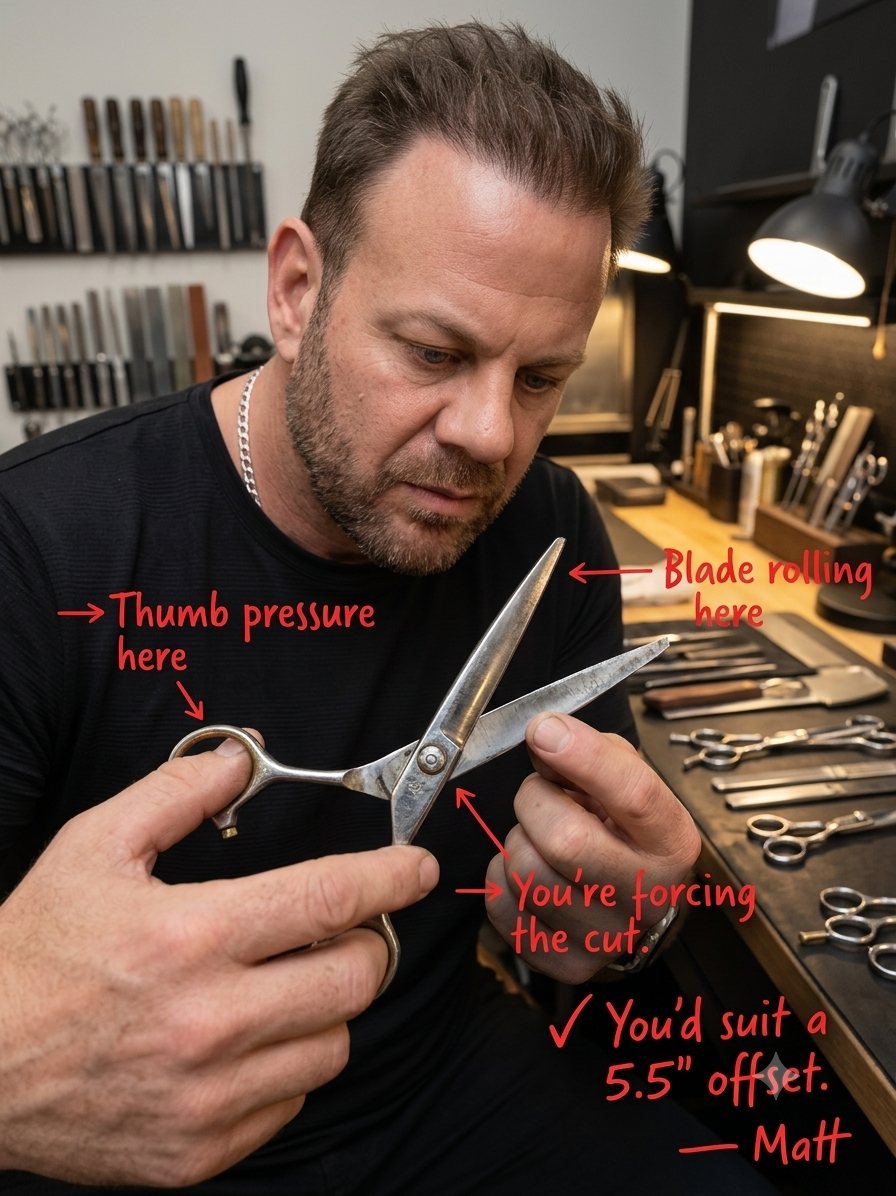
Why hairdressing scissors are different
A craft or kitchen scissor has a simple bevel edge — a flat angle you can touch up on a stone or even a pull-through sharpener. A professional hairdressing scissor has a convex edge: a smooth curve across the width of the blade that slices rather than crushes hair. That curve is the whole reason a good scissor glides through wet or fine hair without pushing or folding it.
You cannot restore a convex edge with a flat stone, a rod, or any rotary machine. The moment a machine touches it, the curve is ground into a flat bevel — the scissor will cut for about a week, then push hair forever after. This is the single most common way good scissors are ruined, and it cannot be undone.
What you can safely do at home
Day to day, “sharpening” a hairdressing scissor is really maintenance — and most “blunt” scissors are simply out of tension or dirty, not dull:
- Check the tension first. Hold the scissor vertically, open the top blade to roughly 90°, and let it fall. It should close about a third to halfway under its own weight. If it slams shut, it is too loose — and loose blades fold hair and feel blunt. Adjust the tension screw an eighth of a turn at a time and re-test.
- Clean and dry after every client. Wipe each blade from screw to tip. Hair, colour and moisture corrode both the edge and the inside ride line.
- Oil the pivot daily. A drop at the screw, open and close a few times, wipe the excess. This protects the bearing and holds the set.
- Run the tissue test. A correctly tensioned, sharp scissor cleanly cuts a single-ply tissue from screw to tip. If it snags only after you have corrected tension, it is genuinely time for a sharpen.
What real sharpening involves (and why it is a craft)
Restoring a hairdressing scissor is hand work on Japanese water stones, not a machine pass. A scissorsmith re-establishes the convex curve at the correct angle, polishes the inside ride line so the blades meet cleanly along their length, and resets the tension before returning the scissor with a fold test. Done properly it takes skill and patience — which is exactly why a thirty-second machine grind is so destructive.
Matt Grumley, the Australian scissorsmith behind ShearGenius’s hand-sharpening service, is the only Australian scissorsmith represented across the international sharpening community, and works every edge by hand on water stones rather than a machine. Whoever you use, ask the four questions before you hand a scissor over: water stones, ride line, tension reset, and a fold test before it is returned. If they cannot answer, find someone who can.
When to sharpen — and when to replace
A well-made scissor in named steel typically holds its edge for six to twelve months of full-time use — longer part-time, and harder named steels often past a year; see the signs your scissors need sharpening for the full checklist. A soft generic-stainless scissor that loses its set within weeks is a different problem: the edge can be restored, but the steel will not hold it, and repeated sharpening is throwing money away. At that point the honest answer is to replace it with a properly forged scissor in named steel.
Left-handed scissors are a separate job
A genuinely left-handed scissor has its blades reversed, so it must be sharpened on the opposite side and its ride line runs the other way. Handed to a sharpener who works almost entirely on right-handed pairs, it can come back with the wrong side ground or the ride flattened — and once the ride is gone the scissor will not hold a set again, no matter how sharp the edge is.
It is a fair question to ask before you hand them over. Anyone who services left-handed scissors regularly will say so without hesitating. For how to tell whether your pair is genuinely left-handed or simply has a mirrored handle, see left-handed hairdressing scissors.
So can you sharpen scissors at home?
Ordinary household scissors — kitchen, craft, fabric — yes: a few strokes on a sharpening stone or even cutting through fine sandpaper will bring back a basic bevel. A professional hairdressing scissor — no. Maintain the tension, keep it clean and oiled, and leave the edge to a scissorsmith who works on stones. Precision is a choice. Professionalism is a habit.
Common questions
Can you sharpen hairdressing scissors at home?
Ordinary household scissors — kitchen, craft and fabric — can take a basic bevel from a sharpening stone. A professional hairdressing scissor cannot: maintain the tension, keep it clean and oiled, and leave its convex edge to a scissorsmith who works by hand on water stones.
What is a convex edge on hairdressing scissors?
A convex edge is a smooth curve across the width of the blade that slices rather than crushes hair. It is why a professional scissor glides through wet or fine hair without pushing or folding it, and it must be restored by hand rather than flattened into a bevel by a machine.
What does real hairdressing scissor sharpening involve?
A scissorsmith restores the convex curve by hand on Japanese water stones, polishes the inside ride line so the blades meet cleanly along their length, resets the tension and completes a fold test before returning the scissor.